
— THE TEACHINGS
The mirror
of your own mind
Nearly a century ago, Krishnamurti saw the world’s crisis coming — and spent sixty years pointing to its only possible source: the human mind itself.
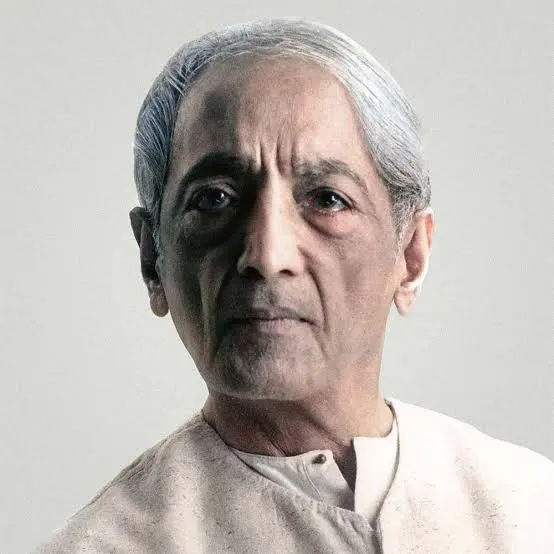
Human history, it seems, has never before witnessed a crisis of the complexity, magnitude, and catastrophic sweep that is being experienced today by mankind and the planet we live on. Its impact is visible in every sphere of our life and is marked by an erosion of values, the collapse of faiths, traditions and ideologies, the breakdown of relationships, and the savage destruction of the earth.
Despite the achievements of our age—the information revolution, the rapid growth of scientific knowledge with its technological skills, and so on—no one can deny that solutions to even the most basic problems such as hunger and insecurity, war, exploitation, and injustice remain remote. What is more, the rapid networking of the world’s societies has ensured that the crisis is brought to every doorstep—yours and mine—without choice, without option.
Nearly a century ago, Krishnamurti saw all this coming. Witness to the dramatic events of the 20th century and endowed with a capacity for acute observation and profound insight, he gave the most brilliant expression to the causes that brought on, and continue to fuel, the global crisis.

Written · London · 21 October 1980
The Core of
the Teachings
When asked in 1974 by his biographer Mary Lutyens to define his teachings, Krishnamurti wrote the following. It remains the most authoritative single statement of what he was pointing to.
The core of Krishnamurti’s teaching is contained in the statement he made in 1929 when he said, “Truth is a pathless land.” Man cannot come to it through any organization, through any creed, through any dogma, priest or ritual, not through any philosophical knowledge or psychological technique. He has to find it through the mirror of relationship, through the understanding of the contents of his own mind, through observation and not through intellectual analysis or introspective dissection.
Man has built in himself images as a fence of security — religious, political, personal. These manifest as symbols, ideas, beliefs. The burden of these images dominates man’s thinking, his relationships and his daily life. These images are the causes of our problems for they divide man from man.
Freedom is not a reaction; freedom is not a choice. It is man’s pretence that because he has choice he is free. Freedom is pure observation without direction, without fear of punishment and reward. Freedom is without motive; freedom is not at the end of the evolution of man but lies in the first step of his existence.
Thought is time. Thought is born of experience, of knowledge, which are inseparable from time. Time is the psychological enemy of man. Our action is based on knowledge and therefore time, so man is always a slave to the past.
When man becomes aware of the movement of his own consciousness he will see the division between the thinker and the thought, the observer and the observed, the experiencer and the experience. He will discover that this division is an illusion. Then only is there pure observation which is insight without any shadow of the past. This timeless insight brings about a deep radical mutation in the mind.
Total negation is the essence of the positive. When there is negation of all those things which are not love — desire, pleasure — then love is, with its compassion and intelligence.
J. Krishnamurti · London · 21 October 1980
Spoken · Ommen, Holland · 3 August 1929
Truth is a
Pathless Land
On the opening day of the annual Star Camp at Ommen, Holland, before 3,000 members of the Order of the Star, Krishnamurti dissolved the organisation built around him and spoke these words.
I maintain that Truth is a pathless land, and you cannot approach it by any path whatsoever, by any religion, by any sect. That is my point of view, and I adhere to that absolutely and unconditionally. Truth, being limitless, unconditioned, unapproachable by any path whatsoever, cannot be organised; nor should any organisation be formed to lead or to coerce people along any particular path.
I maintain that no organisation can lead man to spirituality. If an organisation be created for this purpose, it becomes a crutch, a weakness, a bondage, and must cripple the individual, and prevent him from growing, from establishing his uniqueness, which lies in the discovery for himself of that absolute, unconditioned Truth.
The moment you follow someone you cease to follow Truth. I am not concerned whether you pay attention to what I say or not. I want to do a certain thing in the world and I am going to do it with unwavering concentration. I am concerning myself with only one essential thing: to set man free.
I desire to free him from all cages, from all fears, and not to found religions, new sects, nor to establish new theories and new philosophies. My only concern is to set men absolutely, unconditionally free.
J. Krishnamurti · Ommen, Holland · 3 August 1929
Crisis
Crisis is in You
War
A spectacular bloody
Violence
We are brought up to be violent
Conflict
Division breeds conflict
God
Is God an invention
Belief
Why do you believe
Religion
We have made religion a circus
Relationship
The ending of Relationship
Human Being
You are second hand human beings
Suffering
This vast human suffering
Love
On love and what you call love
Unequel world
An unequal world
Entertainment
The entertainment trap
Freedom
Talking of freedom
Death
You cant argue with death
Earth
The Earth was breathless in it’s splendour
The young
To the young
Forgotten Earth
And the beauty of the earth is forgotten
Fears
You’ve never looked at your fears
Progress
The illusion of progress
Education
Education, a factor of degeneration